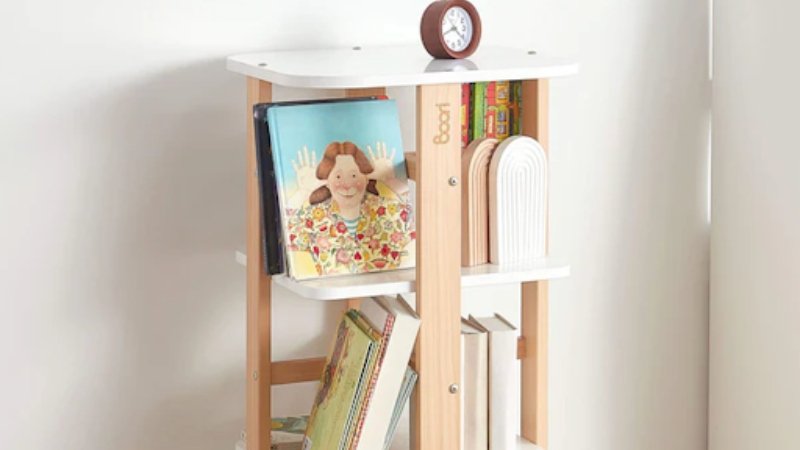
Choosing a children’s bookshelf for a UK bedroom is a purchase decision that most parents make once and expect to live with for several years, yet it receives considerably less research than many less impactful purchases. The bookshelf is the piece of furniture in a child’s bedroom most directly connected to the reading habit that research consistently identifies as one of the strongest predictors of educational achievement across the school years. A bookshelf that presents books visibly and accessibly at the child’s height, built from quality materials to the safety standards appropriate for a children’s bedroom, makes a meaningful difference to how often a child independently reaches for a book across the daily hours they spend in their room.
Key Takeaways
- The display format of a children’s bookshelf, front-facing versus spine-out, has a direct effect on how often young children independently select and read books from it.
- The bookshelf height relative to the child’s eye level determines whether independent book selection is possible from the start, or whether the child always needs adult help to browse.
- Safety specifications including non-toxic finish, wall anchoring provisions, rounded edges, and stable construction are baseline requirements for any bookshelf in a child’s unsupervised bedroom.
- Construction quality determines whether the bookshelf remains structurally sound and visually intact through the years of intensive daily use it will receive in a child’s bedroom.
- Visual integration with the room’s existing furniture creates a coherent bedroom aesthetic that makes the bookshelf feel like a considered part of the space rather than an independently sourced addition.
Children’s Bookshelf Selection Criteria for UK Families
| Criterion | What to Specify | Why It Matters |
| Display format | Front-facing for under-6, spine-out or mixed for older | Determines how often the child self-selects books |
| Shelf height | Lowest shelf at child’s eye level or below | Enables independent browsing without adult help |
| Safety finish | Non-toxic, lead-free, certified | Safe in an unsupervised child’s bedroom |
| Wall anchoring | Provisions included as standard | Prevents tipping in a room used without supervision |
| Construction | Quality timber-based panels, reinforced joins | Structural integrity through years of daily loading |
| Room fit | Width suited to available wall space | Does not crowd the floor area needed for play |
| Visual design | Neutral finish coordinating with bedroom furniture | Integrates with the room rather than disrupting it |
Front-Facing vs Spine-Out: The Most Important Decision
Why Front-Facing Display Matters for Young Children
For children under approximately six years old, who cannot yet reliably read book titles on spines, front-facing display, presenting the full cover of each book outward, is significantly more effective at enabling independent book selection than spine-out storage. A child who sees the full cover of a book can recognise it, identify favourites, and notice books they have not yet read without any adult guidance. The same child facing a row of spines has limited ability to identify what they want to read, reducing independent selection frequency and increasing dependence on adult direction for book choice.
When Spine-Out Storage Becomes Appropriate
Choosing a children’s bookshelf for a UK bedroom is a purchase decision that most parents make once and expect to live with for several years, yet it receives considerably less research than many less impactful purchases. The bookshelf is the piece of furniture in a child’s bedroom most directly connected to the reading habit that research consistently identifies as one of the strongest predictors of educational achievement across the school years. A bookshelf that presents books visibly and accessibly at the child’s height, built from quality materials to the safety standards appropriate for a children’s bedroom, makes a meaningful difference to how often a child independently reaches for a book across the daily hours they spend in their room.
Key Takeaways
- The display format of a children’s bookshelf, front-facing versus spine-out, has a direct effect on how often young children independently select and read books from it.
- The bookshelf height relative to the child’s eye level determines whether independent book selection is possible from the start, or whether the child always needs adult help to browse.
- Safety specifications including non-toxic finish, wall anchoring provisions, rounded edges, and stable construction are baseline requirements for any bookshelf in a child’s unsupervised bedroom.
- Construction quality determines whether the bookshelf remains structurally sound and visually intact through the years of intensive daily use it will receive in a child’s bedroom.
- Visual integration with the room’s existing furniture creates a coherent bedroom aesthetic that makes the bookshelf feel like a considered part of the space rather than an independently sourced addition.
Children’s Bookshelf Selection Criteria for UK Families
| Criterion | What to Specify | Why It Matters |
| Display format | Front-facing for under-6, spine-out or mixed for older | Determines how often the child self-selects books |
| Shelf height | Lowest shelf at child’s eye level or below | Enables independent browsing without adult help |
| Safety finish | Non-toxic, lead-free, certified | Safe in an unsupervised child’s bedroom |
| Wall anchoring | Provisions included as standard | Prevents tipping in a room used without supervision |
| Construction | Quality timber-based panels, reinforced joins | Structural integrity through years of daily loading |
| Room fit | Width suited to available wall space | Does not crowd the floor area needed for play |
| Visual design | Neutral finish coordinating with bedroom furniture | Integrates with the room rather than disrupting it |
Front-Facing vs Spine-Out: The Most Important Decision
Why Front-Facing Display Matters for Young Children
For children under approximately six years old, who cannot yet reliably read book titles on spines, front-facing display, presenting the full cover of each book outward, is significantly more effective at enabling independent book selection than spine-out storage. A child who sees the full cover of a book can recognise it, identify favourites, and notice books they have not yet read without any adult guidance. The same child facing a row of spines has limited ability to identify what they want to read, reducing independent selection frequency and increasing dependence on adult direction for book choice.
When Spine-Out Storage Becomes Appropriate
From around age five or six, when the child can read titles reliably enough to navigate a spine-out bookcase, the priority shifts from front-facing display to storage capacity. An established reader with a growing collection of chapter books and school readers benefits more from a standard adjustable bookcase with high spine-out capacity than from a lower-capacity front-facing display unit that cannot hold the full collection.
The Mixed Format Approach
A mixed format bookshelf or a combination of a front-facing display shelf for current favourites and a standard bookcase for the broader collection works well across the full primary school age range, providing the browsing accessibility of front-facing display for the titles in active rotation while accommodating the growing collection in spine-out storage alongside.
For a quality range of children’s bookshelves in front-facing and standard formats suited to UK children’s bedrooms, visit https://boori.co.uk/collections/bookshelves and browse the full collection.
Frequently Asked Questions
How many books should a children’s bookshelf hold?
The active displayed selection of 15 to 20 books is more effective at driving reading engagement than displaying the full collection at once. A bookshelf with enough capacity for 15 to 20 front-facing titles in active display, supplemented by stored rotation stock in a separate storage area, provides the optimal reading environment for most UK primary school children.
Should a children’s bookshelf be positioned at adult or child height?
At child height, always. The lowest shelf should be at or below the child’s eye level when standing. A bookshelf with all books above the child’s comfortable reach requires adult help for every browsing and selection session, which removes the independent reading habit that the bookshelf is intended to support.
What wall fixing does a children’s bookshelf need in a UK bedroom?
A steel anti-tip bracket fixed to a wall stud or solid masonry rather than into plasterboard alone. Many UK walls are dot-and-dab plastered with no solid fixing behind the plasterboard, making stud or masonry fixing essential. A bookshelf that is only fixed into plasterboard without hitting a stud or solid wall behind it is not safely anchored.
Is a wall-mounted bookshelf safer than a freestanding one for a UK child’s bedroom?
A properly wall-mounted shelf eliminates the tipping risk that a freestanding bookshelf presents if not correctly anchored. The disadvantage is that wall-mounting requires solid fixings, leaves marks on the wall when removed, and typically provides less capacity per unit of wall space than a freestanding bookcase. A correctly anchored freestanding bookcase from https://boori.co.uk/collections/bookshelves provides comparable safety to a wall-mounted shelf when the anti-tip bracket is properly fixed to a stud or solid wall.
Final Thoughts
A children’s bookshelf chosen with the correct display format for the child’s age, the right height for independent access, appropriate safety specifications, and quality construction serves as the physical foundation of the reading habit across the primary school years. The decisions made at the point of purchase, particularly the choice of display format and the confirmation of safety specifications, determine whether the bookshelf actively supports reading or simply provides somewhere for books to be stored and forgotten.
The Mixed Format Approach
A mixed format bookshelf or a combination of a front-facing display shelf for current favourites and a standard bookcase for the broader collection works well across the full primary school age range, providing the browsing accessibility of front-facing display for the titles in active rotation while accommodating the growing collection in spine-out storage alongside.
For a quality range of children’s bookshelves in front-facing and standard formats suited to UK children’s bedrooms, visit https://boori.co.uk/collections/bookshelves and browse the full collection.
Frequently Asked Questions
How many books should a children’s bookshelf hold?
The active displayed selection of 15 to 20 books is more effective at driving reading engagement than displaying the full collection at once. A bookshelf with enough capacity for 15 to 20 front-facing titles in active display, supplemented by stored rotation stock in a separate storage area, provides the optimal reading environment for most UK primary school children.
Should a children’s bookshelf be positioned at adult or child height?
At child height, always. The lowest shelf should be at or below the child’s eye level when standing. A bookshelf with all books above the child’s comfortable reach requires adult help for every browsing and selection session, which removes the independent reading habit that the bookshelf is intended to support.
What wall fixing does a children’s bookshelf need in a UK bedroom?
A steel anti-tip bracket fixed to a wall stud or solid masonry rather than into plasterboard alone. Many UK walls are dot-and-dab plastered with no solid fixing behind the plasterboard, making stud or masonry fixing essential. A bookshelf that is only fixed into plasterboard without hitting a stud or solid wall behind it is not safely anchored.
Is a wall-mounted bookshelf safer than a freestanding one for a UK child’s bedroom?
A properly wall-mounted shelf eliminates the tipping risk that a freestanding bookshelf presents if not correctly anchored. The disadvantage is that wall-mounting requires solid fixings, leaves marks on the wall when removed, and typically provides less capacity per unit of wall space than a freestanding bookcase. A correctly anchored freestanding bookcase from https://boori.co.uk/collections/bookshelves provides comparable safety to a wall-mounted shelf when the anti-tip bracket is properly fixed to a stud or solid wall.
Final Thoughts
A children’s bookshelf chosen with the correct display format for the child’s age, the right height for independent access, appropriate safety specifications, and quality construction serves as the physical foundation of the reading habit across the primary school years. The decisions made at the point of purchase, particularly the choice of display format and the confirmation of safety specifications, determine whether the bookshelf actively supports reading or simply provides somewhere for books to be stored and forgotten.