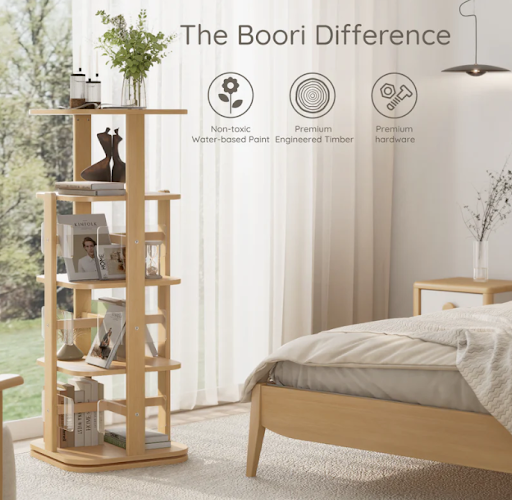
The difference between a front-facing bookshelf and a spine-out bookshelf is simple to describe and significant in its effect. A front-facing bookshelf displays book covers facing outward so the child can see the full cover image of every book on the shelf. A spine-out bookshelf stores books with only the narrow spine visible, which shows the title and sometimes a small author name. For adults who can read titles fluently and who remember which books they own, the spine-out format is efficient. For children under six who navigate almost entirely by visual recognition of cover imagery, it is a format that makes independent book selection genuinely difficult.
Key Takeaways
- Children under six navigate books primarily by cover image rather than by title, which makes front-facing display significantly more effective for independent book selection at this stage.
- Research in early childhood literacy and library design consistently supports the idea that visible book covers increase the frequency with which children self-select reading.
- Front-facing bookshelves are not just more engaging for young children. They are more functional, because the child can actually identify and choose from what is displayed.
- The transition from front-facing to spine-out shelving typically suits children from around age five or six, when reading independence is established and title navigation becomes reliable.
- The number of books displayed on a front-facing bookshelf matters. A curated selection of 15 to 20 books produces more engagement than an overcrowded display where individual covers are hard to distinguish.
How Children Navigate Books at Different Ages
| Age Range | Primary Navigation Method | Best Shelf Format | Why |
| 6 months to 2 years | Object recognition, familiar images | Front-facing at floor level | Responds to visual recognition of favourites |
| 2 to 4 years | Cover image and colour | Front-facing | Cannot read titles, needs full cover visible |
| 4 to 6 years | Cover image plus memory of content | Front-facing | Beginning to use titles but still cover-led |
| 6 to 8 years | Title and cover image combined | Mixed front-facing and spine-out | Can navigate spines but still prefers covers |
| 8 years and up | Title navigation reliable | Spine-out with high capacity | Reading independence established |
The Science Behind Cover Display
The effect of book cover visibility on selection rates has been studied in early childhood classrooms, public libraries, and home reading environments. The findings are consistent: when book covers are visible, children select books significantly more often than when only spines are shown. The effect is largest for children aged two to five, where the difference in selection rates between cover-forward and spine-out display can be substantial.
The mechanism is straightforward. Young children’s visual memory for book covers is strong. They remember the feel, the colour, and the character of a book they enjoyed by its cover image. When that image is visible on the shelf, recognition triggers selection. When only the spine is visible, the memory cue is absent and the book effectively does not exist for the child as a browsing option.
What a Front-Facing Bookshelf Needs to Work Well
The Right Slot Depth
Front-facing slots need to be deep enough to hold the book upright without it tipping forward, but shallow enough that the full cover is visible rather than sitting in a deep recess. The standard depth for a well-designed children’s front-facing bookshelf is 10 to 15 centimetres. A slot deeper than this pushes the book back so the lower portion of the cover is hidden, which defeats the purpose of front-facing display.
A Lip at the Base of Each Slot
Each slot on a front-facing bookshelf needs a small raised lip at the front to prevent books from sliding out when the child is browsing or when the shelf is moved. The lip should be high enough to retain the book securely but low enough not to obscure the bottom of the cover image. A lip of around 2 centimetres achieves this balance on most picture book formats.
Correct Height Placement
A front-facing bookshelf positioned too high removes all the benefit of the front-facing format. If the child cannot see the covers clearly from a natural standing position, the display is no more functional than a spine-out shelf at the wrong height. The display slots should sit between the child’s knee height and eye level, with the most-used titles at the most comfortable viewing height.
A Curated, Not Exhaustive, Selection
A front-facing bookshelf with 40 books displayed in closely packed slots is less effective than one displaying 18 books with clear space between each cover. When individual covers are easy to distinguish, browse, and select from, children engage with the display more productively. When the display is crowded, the visual clarity that makes front-facing effective is lost.
When to Transition to Spine-Out Shelving
The transition from front-facing to spine-out shelving is not a fixed milestone but a practical response to how the child’s reading habits are developing. The right time to add spine-out shelving is when the child is reliably choosing books by title rather than by cover image, which typically happens from around age five or six for most children. At this point, a standard bookcase with adjustable shelves can accommodate the larger collection that accompanies established independent reading, while the front-facing shelf remains for current favourites and newly introduced titles.
For a well-designed range of front-facing and standard children’s bookshelves, visit
https://boori.com.au/collections/bookshelves-bookcases.
Frequently Asked Questions
Can a front-facing bookshelf hold enough books for a child’s collection?
A front-facing bookshelf is not designed to hold an entire collection. It is designed to display the active selection clearly. Between 15 and 25 books in active display, rotated regularly from a stored collection, is the appropriate operating capacity for a front-facing shelf. The stored collection can be held in a standard spine-out bookcase, a storage box, or a separate shelf, and rotated in every few weeks.
Are front-facing bookshelves more expensive than standard ones?
Not necessarily. Front-facing shelves are available across a range of price points. The design is slightly more complex than a simple flat shelf, but the material and construction costs are comparable. The more meaningful distinction is quality: a front-facing shelf with solid construction, a proper lip on each slot, and stable wall anchoring is worth more than a cheaper version that wobbles or whose slots let books fall forward.
Do front-facing bookshelves work for older children too?
Yes, though the benefit decreases as the child develops stronger title navigation skills. Many families keep a front-facing shelf for current favourites and newly introduced books even as the child moves toward spine-out shelving for the majority of the collection. The front-facing display continues to catch the child’s attention and prompt reading of titles that might otherwise be forgotten in a spine-out bookcase.
How do I stop books falling out of front-facing slots?
Choose a front-facing bookshelf with a well-designed slot lip of at least 1.5 to 2 centimetres. Avoid slots that are too wide for the books being stored, as wider slots let books lean sideways rather than sitting upright. Keep each slot to one book, not two books side by side, which removes the lip’s effectiveness.
Final Thoughts
The case for front-facing bookshelves in a young child’s room is not primarily aesthetic. It is functional. A front-facing bookshelf makes independent book selection genuinely possible for a child who cannot yet navigate spine titles, which is the prerequisite for independent reading. Without the ability to see and choose, there is no independent reading. With it, reading happens naturally, frequently, and without adult direction. The bookshelf format is one of the simplest and most impactful changes in a child’s reading environment.